
A crash game is a round-based casino format built on one rising multiplier: it starts at 1.00x, climbs in real time, and stops at a randomly determined point. A player who cashes out before the stop keeps the multiplied stake; everyone still in the round loses it. The mechanic is settled. What is not settled is how much shelf space operators give it. Blask genre content share, which measures how much of a market’s tracked lobby catalogue belongs to a genre, shows crash holding 6.88% in Brazil and 5.38% in Turkey and India in July 2026 — and 2.62% in the United States, down from 11.20% a year earlier. This guide explains the mechanic, then shows where crash is gaining and losing lobby share, which titles anchor it, and how the category behaves next to slots, Plinko and Mines. Crash grew in most tracked markets over the year to July 2026, and the exceptions are as informative as the gains. Turkey added 3.66 points of genre content share and India 1.40, while Ethiopia went from no crash presence to 4.95%. Brazil remains the largest crash shelf at 6.88%. What is a crash game in simple terms. It is a fast betting format built around one rising multiplier and one brutal cutoff point. A round starts at 1.00x, climbs in real time, and ends without warning. If the player exits before the break, the return is locked in. If not, the stake disappears. That clear risk curve is the whole point, and it is why the format feels so immediate on mobile and desktop alike. Unlike slots, this format does not hide the action behind reels or paylines. The tension sits on the screen in plain sight. That visibility makes the genre feel more interactive, even though randomness still controls the final stop. In most versions, everyone in the same round sees the same result, which adds a communal edge and helps explain why crash gambling became a social product as well as a casino product. An online crash game also appeals to players who want speed without complicated rules. There is no long paytable to study and no bonus wheel to decode. The decision is brutally simple. Stay in and chase a bigger number, or leave early and protect the stake. That stripped-down structure is the reason the category broke out far beyond crypto circles. Most crash casino games follow the same mechanical loop. A short betting window opens. Stakes are placed. The multiplier starts rising. The round can stop at any instant, even near the opening point. Players who have already exited get paid according to the number shown at cash-out. Everyone else loses that round. The multiplier is the heartbeat of the whole format. It begins at 1.00x and rises quickly, often with a plane, rocket, line graph, or animated character tied to the climb. The longer it runs, the larger the possible return becomes. Yet the same delay increases danger, because the stopping point is random and can arrive at any height. This mechanic creates a very specific emotional rhythm: That rhythm is why crash gambling feels closer to a reflex test than a traditional spin. Cash-out is where the whole game becomes personal. The system generates the result, but the player still decides when to leave. That tiny slice of control changes the emotional texture completely. In slots, the outcome is already sealed after the spin. Here, the player sees the number climbing and must choose the exit moment in real time. A common mistake is waiting for the perfect run every time. That approach usually collapses fast, because most rounds never reach spectacular heights. The smarter view is that each exit point reflects a tradeoff between frequency and upside. Lower numbers hit more often. Higher numbers pay better when they land, but they land less often. A big part of the category’s rise came from transparent math. Many crypto titles use provably fair systems that let players verify round data after the result is revealed. That system usually combines a server seed, a client seed, and a nonce. Together they create a result that can be checked later. Standard regulated titles more often rely on certified RNG and third-party testing instead. Provably fair does not make a result easier to beat. It makes the generation process more visible. On crypto-first products, that matters a lot because users want proof that the multiplier was not altered after the bet was placed. This is one reason many crash gambling sites built their reputation around verification tools rather than flashy themes alone. Automation tools are now standard in serious lobbies. Auto bet places the same stake repeatedly. Auto cash-out closes the position at a preset number, such as 1.50x or 2.00x. These tools do not change the edge, but they reduce impulsive play and remove some of the panic that comes with manual exits. In practice, automation helps with several things: The best crash games in 2026 are not all clones. They use the same rising multiplier logic, yet each one bends the format in a different direction. Some push clean minimalism. Others add missions, boosters, skins, dual bets, or loyalty layers. The Aviator crash game is still the title most people name first. Spribe lists it as a mini game with 97% RTP, and the company also promotes provably fair technology across its platform. That mix of simple design, social familiarity, and strong brand recognition made it the title that dragged the category into the mainstream. Even though the market now sees a steady wave of new crash releases, Aviator still holds a leading position in several key geographies, including Nigeria, India, and Ghana. Blask data shows they are at or near the top of lobby rankings and market adoption. JetX remains one of the strongest alternatives. SmartSoft states an RTP range from 96.2% to 98.9%, supports two independent bets per round, and includes manual or automatic exits. It also adds moderated chat, history, statistics, and event support, which gives it real staying power in competitive lobbies. Chicken Road takes the multiplier…
Articles
Analysis, guides and market insights from the Blask team
KnowledgeCrash games in 2026: how much of the lobby they actually hold



BlaskOne year passed: how Blask became the iGaming industry’s real-time compass.
One year ago a handful of Blask engineers stared at a paper map with five push-pins.


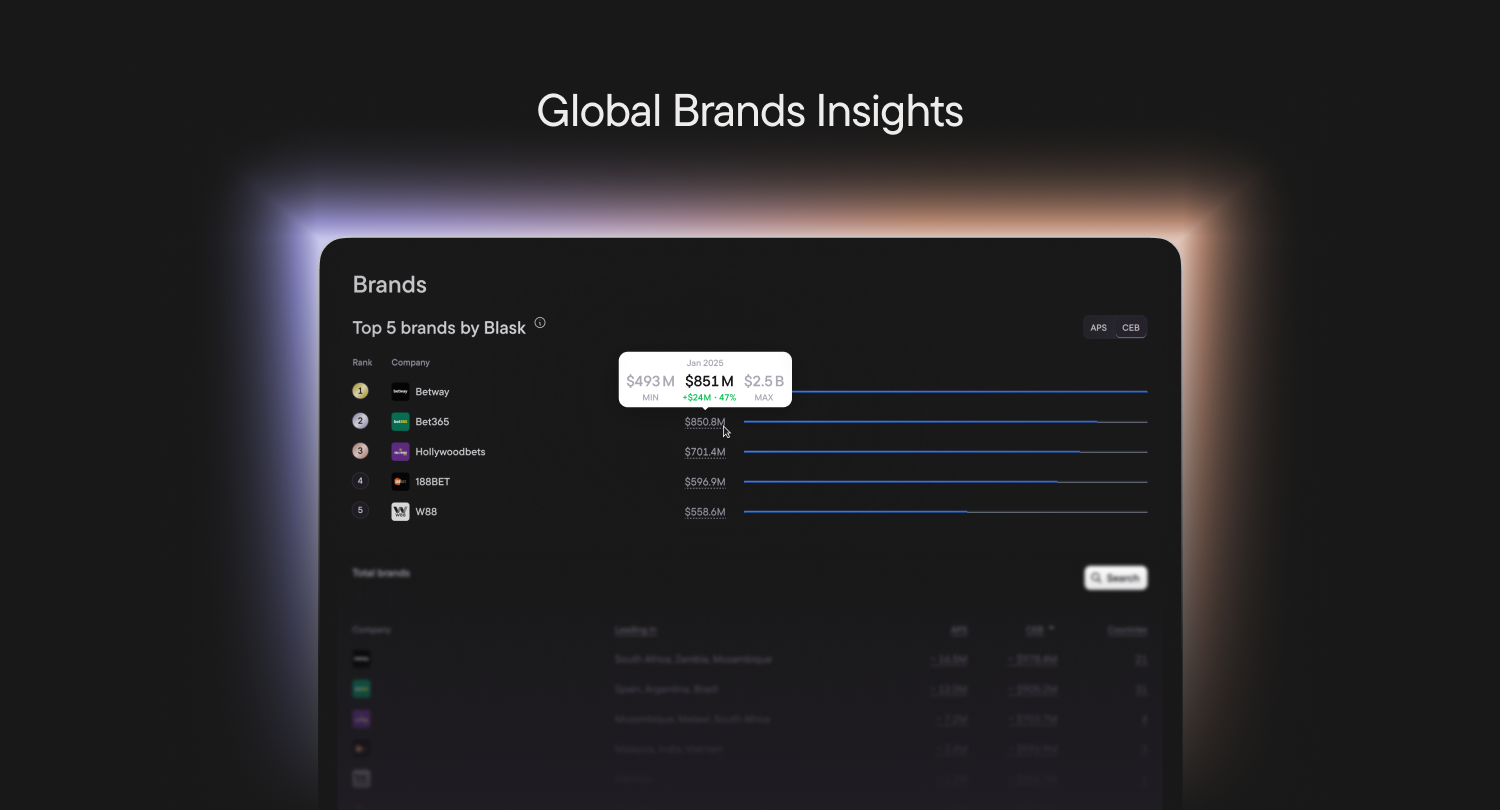
MarketsBlask’s “All Brands” dashboard helps betPawa brand achieve record APS in Africa
Blask’s “All Brands” dashboard has crowned betPawa as Africa’s top iGaming brand, achieving a record 22.24M APS. With a strong mobile-first approach and deep local expertise, betPawa outperforms competitors, proving that advanced analytics drive success in regulated markets.